
From Service to Sustainability: Designing an Entrepreneurial Path for Good Politics
25 April 2026
"From Service to Sustainability: Designing an Entrepreneurial Path for Good Politics"

There is a moment in every political (read it as entrepreneurial) journey that rarely gets spoken about.
It is not the moment of victory.
Not the moment of standing on the stage.
Not even the moment of deciding to enter public life.
It is a quieter, heavier moment.
The moment when a young political leader – deeply committed, full of intent – asks themselves:
“How do I continue?”
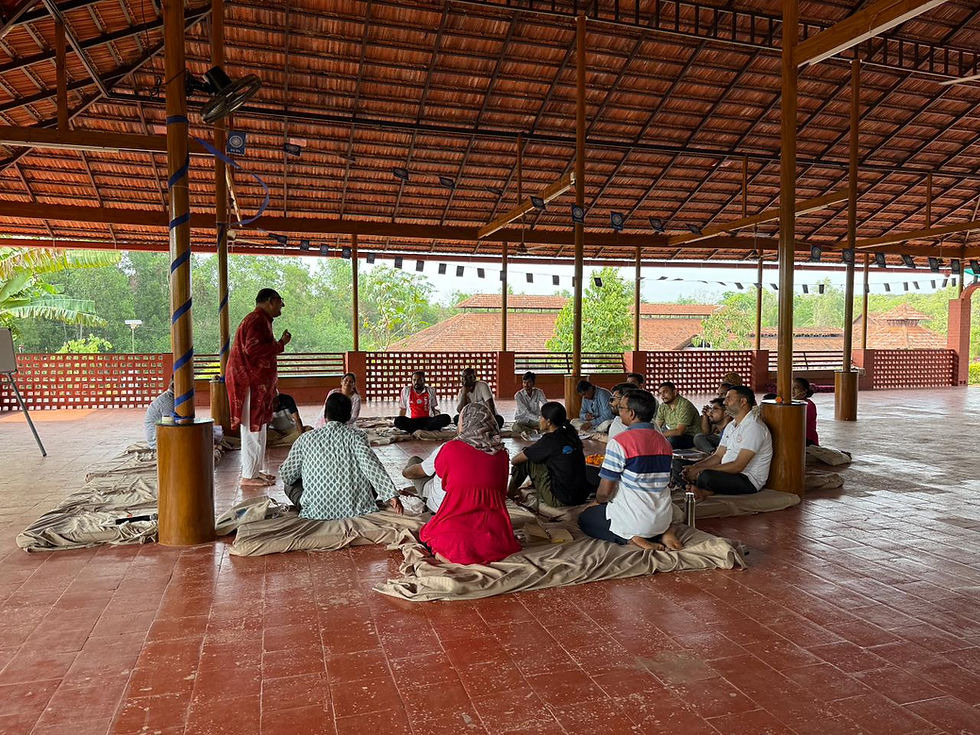
Over the past few days, while facilitating a session with The Good Politician (TGP) fellows at the Indian School of Democracy in Kerala, I found myself sitting with this question – not as a theoretical inquiry, but as a lived reality for every participant in the room.
These were not aspiring politicians in abstraction. They were – elected representatives, party workers, community leaders, individuals deeply embedded in their constituencies.
Each one carried stories of service.
And beneath those stories, almost silently, they carried the weight of survival.
The Invisible Burden of Good Politics
When we speak about politics in India, we often speak about: power, ideology, elections, promises, governance – But rarely do we speak about the economics of staying in politics.
And yet, for a budding politician, this is the most immediate and pressing challenge.
During our conversations, a pattern emerged – consistent, honest and deeply human:
Many struggle with personal financial stability
Some support their teams from their own pockets
Several balance family responsibilities with political commitments
Almost all face uncertainty about long-term sustainability
Let us pause and truly imagine this.
A leader who wants to serve their community but is unsure how to sustain their own livelihood. A leader who wants to build a team but does not know how to pay them consistently. A leader who wants to solve problems but is constrained by lack of resources. At the heart of this lies a deep tension between noble intention and limited resources. I must admit that every participant I interacted with had a strong sense of purpose, desire to create impact and deep commitment to their people. But intention alone does not sustain action.
If this is the reality, then how do we build politicians who do not burn out? How do we enable them to stay – ethically, sustainably and with dignity?

A Shift in Perspective: From Politician to Builder
One of the core ideas we explored in the session was a simple but powerful shift: A politician is not just a representative; a politician is a builder of local economies.
The shift changes everything. Instead of asking how do I get funds? We begin by asking what value exists in my constituency; what economic activity can I enable; How can my work sustain itself?
At School for Social Entrepreneurs India, we have always believed that learning is not about information – it is about transformation through action.
So, instead of giving answers, we created spaces where participants could reflect on their own realities, learn from each other, experiment with ideas and build models grounded in their context.
One of the most powerful realizations for participants was this: Your constituency is not just a geography, it is an economy where money is already flowing through agriculture, services and local markets. The question is not whether there is an opportunity or not, but can they see & shape it or not.

The Framework: From Survival to Sustainability
To help people move from reflection to action, we introduced a simple yet deeply practical framework – one that moves a leader from survival to sustainability. It began with identifying the real problem, not its surface symptoms, but the lived reality people face every day. From there we asked them to trace the existing flow of money – to observe where people are already spending, who is provider of goods and services and where value is being lost. Only then did we move to designing a solution – not something grand or abstract, but something simpler, more efficient, and rooted in context. This led naturally to the question of ongoing revenue: who would pay for this solution, and why would they continue to do so? And finally, we anchored everything in a small start – what could begin immediately, without waiting for perfect conditions. The framework was intentionally simple, because complexity often becomes an excuse for inaction.
As participants engaged in this process, something shifted in the room. Ideas began to take shape – not as distant ambitions, but as grounded possibilities. There were local aggregation models for farmers, waste management systems that generated revenue and community services that people are willing to pay for. These were not large-scale start-up ideas, but real, doable models – rooted in local realities, designed for sustainability, and aligned with the spirit of public service.
Alongside this, a critical question surfaced with honesty and urgency: how does one sustain a team? In grassroots politics, teams are often informal, underpaid, and deeply dependent on the leader. This creates a fragile system, one that struggles to endure. We began to explore a different possibility, what if teams were not dependent, but economically enabled? What if each member was connected to a livelihood stream, each role created value, and everyone earned with dignity? In that shift, the nature of leadership itself transforms—from dependency to ownership, from cost to capability, from fragility to strength.
Perhaps the most sensitive, yet most essential, conversation was around personal sustainability. There is often hesitation in acknowledging the need for income in public life, but the truth is undeniable: a leader constantly worried about survival cannot fully commit to service. And so we asked, with clarity and care—what are the ethical income streams you can build? How can your own skills create value? How might you design a life where service is not a burden you carry, but a path you can sustain?
Towards Happy Politicians
This brings us to an important idea: What would it take to create ‘Happy Politicians’? Not in the superficial sense of comfort, but in a deeper sense – emotionally secure, financially stable, purpose driven and community rooted. Because a happy politician will think long-term, act with integrity and sustain impact with trust.
And this is where entrepreneurship becomes powerful – not as business, but as a way of thinking.
Entrepreneurship teaches opportunity recognition, resourcefulness, value creation, risk-taking, iteration. And for politicians, this translates into designing solutions instead of reacting to problems in the constituency, building systems instead of distributing benefits to their people and creating value instead of managing scarcity.
Changing the Narrative
If we were to imagine the future of Indian politics, it may rest on four pillars:
Purpose – why do I serve?
People – who do I serve?
Product (Value) – what problem am I solving?
Profit (Sustainability) – how does this continue?
This should not be read as a move to commercializing politics, it is about sustaining good people in politics, stabilizing politics and making it aspirational for everyone.
Today, politics is perceived as power-driven, resource-heavy, compromised. But, what if we could shift the narrative? What if politics became value-driven, resource-creative, system-oriented. What if young leaders saw politics not as a space you survive in but as a space you can build within.
The Final Reflection
As the session ended, we invited participants to reflect on one simple statement – “Even if it is difficult… I will stay in public life because…” This was one of the most spectacular and eye-opening sessions we experienced with very dynamic leaders from across the country.
Good politics is not sustained by intention alone; it is sustained by leaders who choose to stay. Politics does not need more heroes; it needs more people who can sustain their courage over time.
Democracy does not weaken because there are no good people in politics, it weakens when good people cannot afford to stay.
If you are someone thinking ‘Should I enter politics?’, let me say clearly – Yes, we need you. But come prepared. Come not with just passion, anger, idealism but also with clarity, skills and financial awareness.
We need more people in politics. But not those who burn-out, compromise, struggle silently but we need people who think clearly, build sustainably and stay courageously.